How Meditation Reshapes the Brain
Maybe you know that feeling when you finish a guided meditation session and everything just feels … different?
Softer around the edges. Your thoughts aren’t racing quite as much. It’s not just in your head (well, technically it is, but you know what I mean) – neuroscience is now showing us that meditation actually rewires the brain. Like, physically changes it.
For years, meditation was this vague spiritual thing. People reported that it worked, but nobody really knew how and why. And science frankly didn’t really care.
But in the last fifteen years or so, brain researchers became more interested and have been able to see what exactly happens under the hood. And it turns out the brain has this incredible ability called neuroplasticity. A fancy word basically meaning that your brain rewires itself based on what you do. New connections form. The physical structure shifts. So when you sit down to meditate? You’re literally training your brain. Not metaphorically. Literally.
Harvard researchers, along with teams at MIT and the University of Wisconsin-Madison, have documented these changes. They’re seeing increased gray matter in certain areas, neural pathways connecting differently, shifts in how active different regions are. Sometimes this happens after just two months of regular practice.
What makes this fascinating is that we’re not talking about mystical energy or anything abstract here. This is stuff you can see on an MRI scan. Hard evidence. The kind of data that links our quietest moments to measurable brain growth.

What Harvard Found After Just Eight Weeks
Let’s talk about the probably most famous study in this field. A mindfulness program, only eight weeks/ roughly two months long, and performed by scientists at Harvard Medical School and Massachusetts General Hospital. You can read it here: Psychiatry Research: Neuroimaging. But we’ll explain it, so you don’t have to.
Essentially: participants meditated about 27 minutes a day. Guided stuff, nothing fancy. They did MRI scans before and after. And what showed up surprised even the researchers who’d designed the study.
The gray matter density increased in the hippocampus. That’s a region that handles learning and memory. Short-term meditation was strengthening the exact parts of the brain that help with emotional regulation and clear thinking. They also saw growth in areas tied to self-awareness and empathy, the so called posterior cingulate cortex and temporo-parietal junction – fancy words. But don’t worry, these are just the regions that activate when you think about yourself or try to understand what someone else is feeling.
But here’s the really striking part: the amygdala (your brain’s “fight or flight” panic button) actually shrank. Less gray matter density. And this shrinkage correlated directly with participants reporting lower stress levels. The control group? Nothing. Imagine this: a shrunken amygdala after only two months in those wo practiced guided meditations. Compared to no changes at all in those who didn’t.
The conclusion? Unavoidable: this incredible brain change was not the result of e.g. time passing or people feeling more relaxed in general. It was explicitly the meditation practice causing this. Needless to say that this study was a massive turning point.
For the first time, scientists from renowned institutions had shown that measurable structural changes in the adult human brain could (and would) happen in as little as eight weeks of guided meditation.
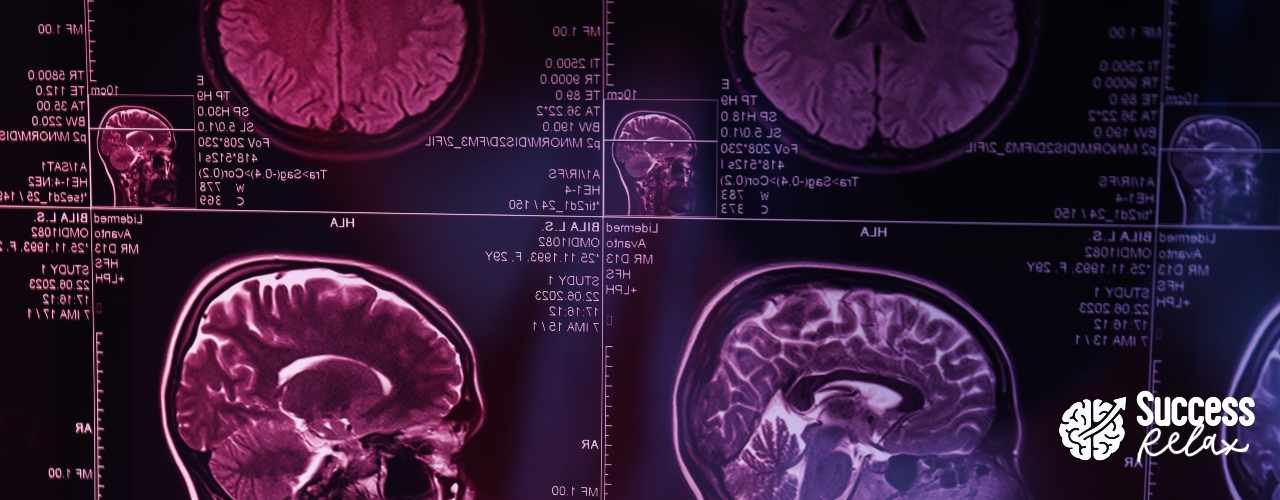
What could be observed in Magnetic Resonance Imaging (MRI) and Functional Magnetic Resonance Imaging (fMRI)
When neuroscientists checked meditating brains through MRI and fMRI (functional MRI), they didn’t just find subtle and mild hints. No, entire patterns of brain activity were transformed.
fMRI measures activity by tracking blood flow changes. It’s like watching the mind think, feel or quiet down. And in people who meditate, that quietness has a very distinct look.
Research at Harvard and Boston University showed this beautifully. As mentioned before, the participants completed a mindfulness course that took only eight weeks. And then were shown emotionally charged images during an fMRI scan. Before the meditation practice, the amygdala lit up like crazy. But after eight weeks? Same people and much calmer amygdala response. Even though they weren’t actively meditating during the scan.
It’s evident that their brains had learned a completely new, lower baseline of tranquility, calm, peace, coolness or whatever you want to call it.
University of Wisconsin-Madison researchers found similar patterns in both beginners and experienced meditators. Even after a short meditation course, the beginners showed increased connectivity between the amygdala and the ventromedial prefrontal cortex. Translation: the brain’s “thinking” regions were learning to regulate the emotional ones. And with long practice, this gets more efficient. Emotional regulation becomes easier, more automatic.
The default mode network also changes – that’s the brain regions that activate when your mind wanders or you’re ruminating. Already after a few weeks of meditating, important brain areas responsible for self referential thinking and mind-wandering (posterior cingulate cortex and precuneus) became less active. This matches well with what meditators describe: quieter inner dialogue, less mental chatter, more presence.
Over time, these shifts become the biological fingerprints of meditation. A mind that’s literally rewired itself toward calm awareness.
What? A Mandala? Which Vortex again?
No no, not mandala, not vortex. Amygdala and Cortex. But we get it: you are probably not a medical doctor and you probably don’t know what all the different brain regions are called and what they do. Now don’t you worry. We’ll explain it all.
The Prefrontal Cortex gets thicker
The prefrontal cortex is right behind your forehead. It deals with your focus, decision-making and your emotional regulation. Quite an important region (ok ok, they all are). The crazy part: Studies show that when you meditate, your prefrontal cortex gets thicker and more active. That means: you profit from better concentration and a better impulse control. Just think of it as strengthening your brain-“muscle” for clarity and choice. Instead of automatically reacting to stress, you will be able to pause. And to respond thoughtfully. Acting instead of just reacting. Be more in control.
A shrinking Amygdala
The amygdala, a tiny little bean located deep within our brain, which huge impact on our lives. It’s the reason why we experience fear, anxiety, and panic. Imagine what most people would give to shrink it and profit from less of these limiting feelings. The good news: regular meditation shrinks it. And that has been proven by MRI scans. The results is a less reactive amygdala/fear center. And that happens even when you aren’t actively meditating at that time (https://news.harvard.edu/gazette/story/2018/03/how-mindfulness-may-bring-about-depression-relief/). So it’s not an effect that happens only during the meditation. It has a long lasting effect. Meaning: regular meditation makes you feel calmer and less anxious in your life.This impact is absolutely incredible when you think about it and what it means!
More gray matter in the Hippocampus
The Hippocampus is very important for your memory and learning. However, it’s also really sensitive to stress. And, you guessed it, the Harvard study showed gray matter increases here. And that means that meditation protects and strengthens it (https://news.harvard.edu/gazette/story/2011/01/eight-weeks-to-a-better-brain). More emotional balance and mentally clearity? Nice! Makes it easier to learn and emotionally regulate. Not bad for a practice that takes only 30 minutes a day now, is it?

The Pace of Transformation: What the Brain Does When You Sit Still
One of the loveliest surprises in meditation research is just how quickly the brain begins to cooperate. The idea that neuroplasticity takes years of rigorous training turns out to be – well, only partly true. The brain is a remarkably eager student, and a few quiet weeks can already set it in motion.
In the First Weeks: Early Sparks of Change
In multiple independent studies, significant structural and functional shifts have appeared after only eight weeks of daily practice. Harvard researchers observed measurable growth in gray matter within the hippocampus and a simultaneous reduction in the amygdala’s size (Harvard Gazette). That’s the brain’s memory system getting sturdier while its stress center relaxes.
Sometimes, the process starts even sooner. Functional MRI scans show reduced amygdala reactivity to stress after only two to four weeks of consistent meditation. Imagine a fire alarm that begins learning the difference between burnt toast and an actual fire. The brain is recalibrating its threat-detection system, one breath at a time.
At this stage, nothing dramatic feels different – perhaps a little more patience, a few less spiraling thoughts – but under the surface, the neural tone is already shifting from tension toward coherence.
Over Months and Years: The Slow Architecture of Calm
Fast forward several months – or better, a few years – and the changes begin to integrate. What was once a fluctuation becomes a trait. Emotional steadiness stops being something you “do” and turns into how the brain runs by default.
In a study led by Richard Davidson and colleagues at the University of Wisconsin-Madison, short-term meditators showed reduced amygdala activity mainly in response to positive or neutral images. Long-term practitioners, however – those with thousands of hours logged – showed dampened reactivity even to negative or stressful stimuli (UW-Madison News).
It’s as though experience sculpts precision into compassion. The brain learns not just to stay calm, but to understand which reactions are worth having. Early practice smooths the waves; longer practice stills the tide.
Sustaining the Benefits: Keeping the Circuits Tuned
Like physical fitness, mental clarity is a perishable good. Neural gains fade when the practice halts completely. The structural changes – such as gray matter increases – linger longer, but functional calmness thrives only with use.
Think of it as neuro-gardening. Synapses that are not “watered” by attention start to prune themselves. Regular meditation keeps the pathways open, the electrical chatter harmonious. The brain rewards constancy with grace.
The metaphor is almost literal: stop meditating, and some calm remains; keep meditating, and calm matures into resilience. It’s not magic. It’s maintenance.
From First Steps to Lifelong Practice:
The Brain Learns in Layers
When researchers place both beginners and long-term meditators inside an MRI scanner, the differences appear not as a competition but as a time-lapse. Each brain tells a story in a different verb tense: becoming versus being.
The Early Phase: Laying Down the Foundations
For newcomers, the first few weeks often deliver surprisingly tangible payoffs. Attention steadies, stress reactions mellow, and something like cognitive breathing space appears.
After just eight weeks, scientists have documented stronger communication between the prefrontal cortex and the amygdala – the neural conversation between judgment and emotion grows more fluent (UW-Madison News).
Meanwhile, the brain’s default-mode network, that chatty narrator responsible for mind-wandering, quiets down (Nature / Scientific Reports). Less daydream static, fewer loops of “what if.” People describe it as having a clearer signal underneath the usual mental noise.
It’s a little like discovering that your mind comes with a volume knob – and realizing you can turn it down without losing the music.
Long-Term Practice: Remodeling from the Inside Out
As practice stretches into years, changes deepen into structure. MRI data show thickened cortical tissue in the prefrontal cortex, insula, and sensory regions – areas linked to awareness, empathy, and executive control (Harvard Gazette).
One Harvard study reported that older meditators’ cortices appeared younger than their non-meditating peers’. The typical thinning of the cortex that accompanies aging seemed delayed (Harvard Gazette). It’s as if the act of paying attention slows the quiet erosion of time.
Emotionally, seasoned practitioners show muted amygdala activity even under strong negative stimulation (UW-Madison News). Their brains still register stress, but the response resembles acknowledgment more than alarm. Calmness becomes the baseline rather than the goal.
In other words, what starts as deliberate regulation transforms into spontaneous equilibrium – the difference between steering and gliding.
Gray Matter: The Brain’s Growing Garden
If you imagine gray matter as the fertile topsoil of consciousness, meditation seems to act like careful cultivation. Repeated attention, gentle awareness, deliberate stillness – these are the sunlight and water of neural growth.
Multiple studies have shown increases in gray-matter density in the hippocampus, prefrontal cortex, and anterior insula after consistent meditation practice (Harvard Gazette). These are the same regions that expand when a person learns piano, juggles, or masters a new language. The skill here is self-regulation.
The longer the training, the more pronounced the structural differences become (Harvard Gazette). The pattern is familiar to neuroscientists: neurons that fire together wire together. “Use it and grow it” isn’t motivational fluff – it’s basic biology.
Yet the field has matured beyond simple headlines. A 2022 meta-study questioned whether brief interventions truly alter anatomy so quickly, suggesting that structural change may require more sustained effort (Psychology Today). Still, functional improvements – better focus, emotional balance – remain consistent.
So perhaps the story unfolds in two chapters: first the brain rehearses new patterns, then it rebuilds around them. Function leads; form follows.
What It All Means in Daily Life
Scientific results make beautiful graphs, but what they really measure is lived texture: the way a morning begins, how quickly a pulse settles after an argument, the steadiness that slips quietly into ordinary moments.
Stress as Signal, Not Storm
When the amygdala calms down (Harvard Gazette), stress doesn’t vanish—it just stops running the show. You still notice the surge of cortisol, the quick breath, the tight shoulders, but the reaction travels through the prefrontal cortex first, where it can be weighed instead of obeyed.
In practice this might look like catching yourself before firing off a defensive email or realizing halfway through a tense conversation that you can actually exhale. It’s not the absence of stress; it’s stress passing through a better-informed brain.
Focus That Learns to Stay
The prefrontal cortex strengthens with practice (Scientific American), and the result feels a bit like tuning a microscope. Tasks that used to scatter attention start to align under a single lens. People often describe this as “mental clearing,” as though thoughts still float by but no longer grab the wheel.
The change is subtle: you don’t force focus; you stop fighting distraction.
Relationships and the Expanding Mind
The same regions that grow through meditation—the hippocampus and temporo-parietal junction—are tied to empathy and emotional understanding (Harvard Gazette). Strengthen them and you naturally listen better. You catch nuance in another person’s tone; you forgive faster.
What’s happening isn’t mystical. The neural circuits that process our own emotions also help us recognize them in others. Self-awareness and empathy share wiring. When you train one, the other wakes up too.
Memory and Learning: The Hippocampus at Work
A balanced hippocampus is like a good librarian: calm, organized, not overwhelmed. Under mindfulness, memory improves—not just recall, but the way new information finds context. Students retain more; professionals notice their creativity loosening. The brain finally has enough quiet to file things where they belong.
Resilience as a Trait, Not a Trick
Long-term meditators show a faster emotional recovery curve after negative events (UW–Madison News). Their amygdala still reacts, but briefly, like a match that flares and goes out instead of setting the forest ablaze.
That’s resilience in neuroscientific terms: the speed of return to equilibrium. It doesn’t mean indifference. It means flexibility.
The Body Echoes the Mind
Physiological benefits follow close behind: lower blood pressure, steadier immune markers, better sleep, less pain (Scientific American).
In expert meditators, pain signals still register, but the brain’s suffering circuits remain quieter. The sting arrives without its story. That’s a remarkable trick of wiring—sensation unaccompanied by panic.
Why All This Matters
Across decades of data—from Harvard’s eight-week studies to long-term imaging at Wisconsin—the message stays consistent. Meditation changes both the form and the function of being human. A thicker cortex, a calmer amygdala, a more integrated network for empathy: these are the visible fingerprints of an invisible practice.
What they translate into is simple: clearer focus, kinder interactions, steadier judgment, and a sort of low-frequency peace that hums beneath daily life. Meditation doesn’t pull you out of the world; it trains you to stay in it with more skill.
Neuroscientist Britta Hölzel once summarized it perfectly: “It is fascinating to see the brain’s plasticity and that, by practicing meditation, we can play an active role in changing the brain and increase our well-being and quality of life.” (Harvard Gazette)
That’s both data and invitation.
A Final Thought: The Brain’s Quiet Willingness to Learn
Perhaps the most heartening discovery in all of this is how open the adult brain remains. It doesn’t fossilize with age; it just waits for direction. Meditation provides that direction—gentle, repetitive, patient.
Each moment of awareness functions like a micro-experiment in neuroplasticity. Every time you return to the breath, the brain rehearses balance. With enough rehearsal, balance becomes design.
Meditation doesn’t create a new self. It uncovers the one that was never completely lost. And now, with the tools of science, we can actually watch that rediscovery unfold—neuron by neuron, breath by breath.
References and Further Reading
- Harvard Gazette – Eight weeks to a better brain
- Harvard Gazette – How mindfulness may bring about depression relief
- Harvard Gazette – Meditation found to increase brain size
- Scientific American – What Does Mindfulness Meditation Do to Your Brain?
- UW–Madison News – How meditation changes brain and body
- Nature / Scientific Reports – Yang et al. (2019): Eight-week meditation program changes in the brain
- Psychology Today – Mindfulness: 8 Weeks Didn’t Change Brains – and Why That’s OK
- SuccessRelax – Success Related Meditation App for iOS and Android